
Discover Your Potential in a Changing Professional Landscape
Are you a student wondering which career to choose after graduation? Perhaps you are already working but feel that your current profession offers limited growth. Or maybe you want to enter a field where you can build a career, work independently or eventually start your own business.
One question worth exploring is: Can digital marketing offer the career opportunities you are looking for?
The Indian business landscape is changing rapidly. Companies are investing in websites, search engines, social media, online advertising and digital customer experiences. According to the ET Brand Equity–Ipsos State of Digital Marketing in India 2025–26 report, digital advertising accounted for ₹49,000 crore, or 44% of India’s total advertising expenditure in FY2025. It recorded 20% year-on-year growth. The report projected another 15% growth in FY2026.
These numbers indicate something important: digital marketing is no longer just an additional business activity. It has become a significant part of how companies attract customers and compete in the market.
For job seekers, this creates opportunities across several specialisations. But what jobs are available? What skills do employers expect? How much can you earn? And will artificial intelligence change these opportunities?
Let’s explore the possibilities and understand how you can build a career in digital marketing.
Why Choose a Career in Digital Marketing?
Imagine a business launching a new product. It needs people who can research the market, identify potential customers, improve website visibility, manage advertisements and measure campaign performance.
These responsibilities create opportunities for trained digital marketing professionals.
Here are five reasons why this field deserves consideration.
Growing business investment: Companies are allocating increasing budgets to digital advertising and online customer acquisition. As businesses compete for online attention, they need people who understand digital marketing.
Multiple career paths: You can specialise in SEO, social media, content marketing, paid advertising, email marketing or analytics. You are not restricted to one type of job.
Opportunities across industries: Healthcare, education, banking, retail, hospitality, real estate, e-commerce and technology companies all use digital marketing.
Freelancing and entrepreneurship: You can work with multiple clients, offer specialised services or eventually establish your own digital marketing agency.
Scope for continuous growth: Digital marketing combines marketing, technology, creativity and data. Learning new tools and developing expertise can open opportunities for professional advancement.
However, it is important to understand that industry growth does not automatically guarantee employment. Your skills, practical experience and ability to deliver results will determine how effectively you can use these opportunities.
Different Career Opportunities in Digital Marketing
One of the biggest advantages of digital marketing is the variety of job roles available. You can start with a general understanding of the industry and gradually develop expertise in a particular area.
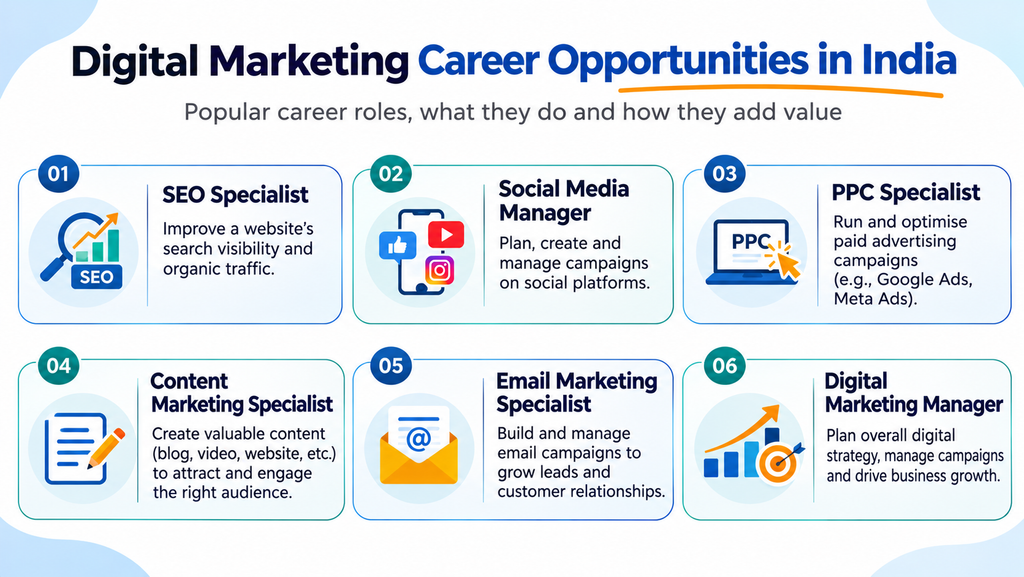
Here are six career options worth exploring.
- SEO Specialist
An SEO specialist helps websites improve their visibility in search engine results. Responsibilities include keyword research, on-page optimisation, technical SEO, content improvements and link-building strategies.
2. Social Media Manager
A social media manager develops and manages a brand’s presence on platforms such as Instagram, Facebook and LinkedIn. The role includes content planning, audience engagement, campaign management and performance analysis.
3. PPC and Performance Marketing Specialist
These professionals manage paid campaigns using Google Ads, Meta Ads and other advertising platforms. They work with budgets, audience targeting, advertisements and conversion data to improve campaign performance.
4. Content Marketing Specialist
Content marketers develop blogs, articles, website pages, videos and other marketing materials. Their objective is to attract relevant audiences, build trust and support business growth.
5. Email Marketing Specialist
Email marketing professionals manage newsletters, promotional campaigns, subscriber lists and automated communication. They help businesses nurture leads and maintain customer relationships.
6. Digital Marketing Manager
A digital marketing manager oversees marketing strategies across different channels. Responsibilities include campaign planning, budgeting, team coordination and performance measurement.
Essential Skills Required for a Career in Digital Marketing
Knowing how to use social media is not enough to become a professional digital marketer. Employers look for people who understand marketing objectives and can use the right tools and techniques to achieve them.
Some important skills include:
Search Engine Optimisation: Learn keyword research, search intent, technical SEO, on-page optimisation and link building.
Social Media Marketing: Understand content planning, audience engagement, platform-specific strategies and social media analytics.
Paid Advertising: Learn Google Ads and Meta Ads, including campaign setup, targeting, budgeting and conversion tracking.
Content and Communication: Develop the ability to write clearly, understand customer requirements and create relevant marketing messages.
Analytics and Reporting: Learn Google Analytics 4 and Google Search Console. Understand website traffic, user behaviour, conversions and campaign performance.
AI and Marketing Automation: Become familiar with ChatGPT and other AI-assisted marketing tools. Learn how to use automation to improve research, productivity and campaign workflows.
A useful approach is to develop a broad understanding of digital marketing first and then specialise in one or two areas.
Educational Qualifications and Eligibility
Do you need an MBA or a technical degree to enter digital marketing? Not necessarily.
Students who have completed Class 12 can begin learning digital marketing fundamentals. Graduates from commerce, arts, science, engineering and management backgrounds can also explore this profession.
A degree in marketing or business management may be helpful, particularly for certain management positions, but it is not compulsory for every role.
Professional certifications can demonstrate your knowledge. However, employers also want to see whether you can perform actual marketing tasks.
For example, knowing what keyword research means is different from conducting keyword research for a business website.
Focus on developing practical abilities alongside theoretical knowledge. That combination will make your profile more valuable.
Digital Marketing Salary in India
Salary is naturally an important consideration when choosing a career. Digital marketing compensation depends on your specialisation, experience, location, employer and ability to demonstrate results.
According to Foundit’s Salary Trends Report, October 2025, the reported salary ranges for professionals in digital marketing were as follows:
| Experience | Annual salary range |
| 0–3 years | ₹2.90–4.61 lakh |
| 4–6 years | ₹7.42–11.43 lakh |
| 7–10 years | ₹11.25–14.20 lakh |
| 11–15 years | ₹15.20–21.80 lakh |
| 15+ years | ₹22.25–30.48 lakh |
These are reported market ranges, not guaranteed salaries for every job role or candidate.
What Influences Your Salary?
Three factors can make a difference:
- Specialisation: Expertise in performance marketing, SEO, analytics and automation can help differentiate your profile.
- Practical experience: Employers value professionals who have managed actual campaigns and understand measurable outcomes.
- Business understanding: Knowing how marketing contributes to leads, sales and customer acquisition makes you more valuable than someone who only understands individual tools.
Freelancing and consulting also offer alternative income opportunities, although earnings depend on your clients, pricing and ability to deliver consistent results.
How to Start a Career in Digital Marketing
If you are starting from scratch, you do not need to learn every digital marketing tool or platform immediately. What you need is a structured learning and practice plan.
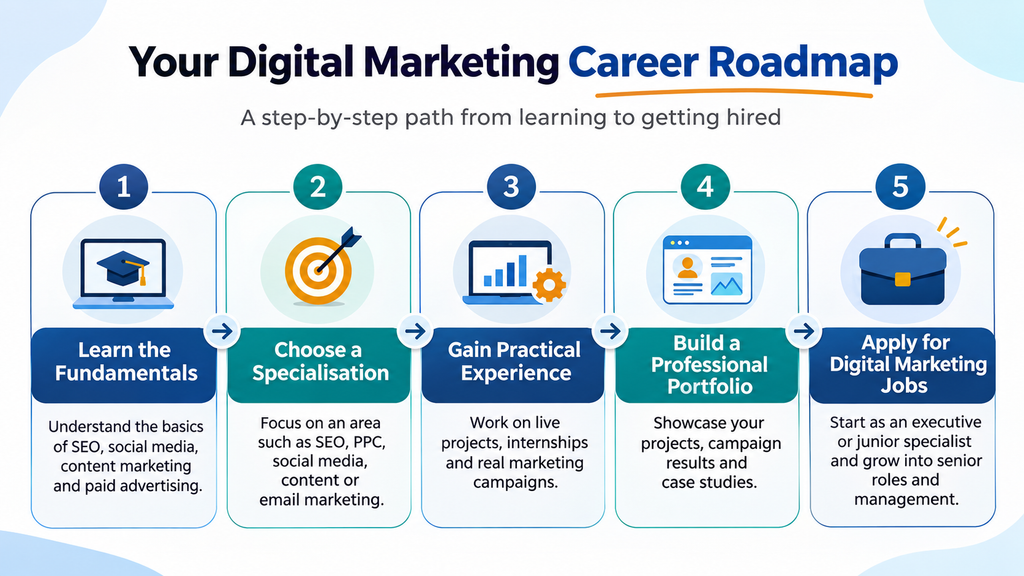
Here is a practical five-step approach.
Step 1: Understand the Fundamentals
Begin with SEO, social media marketing, content marketing, paid advertising and email marketing. Understand how these channels work together to support business objectives.
Step 2: Select Your Specialisation
Identify the area that interests you most. If you enjoy research and analysis, explore SEO. If you like creativity and communication, consider content or social media marketing. If you enjoy numbers and optimisation, explore performance marketing.
Step 3: Work on Practical Projects
Create a website or blog, conduct keyword research, prepare a social media calendar or develop a sample advertising campaign.
Practical assignments help you understand real marketing challenges.
Step 4: Build a Portfolio
Document your projects and work samples. Include campaign plans, website improvements, content samples and results wherever available.
A good portfolio can help you demonstrate your abilities during interviews.
Step 5: Apply for Internships and Jobs
Start with internships and entry-level opportunities. Apply to digital marketing agencies, startups, e-commerce companies and businesses with in-house marketing teams.
Do not wait until you know everything. Build your skills, gain experience and improve as you progress.
Popular Digital Marketing Tools to Learn
Digital marketing professionals use different tools for research, campaign management and performance measurement.
Here are some useful starting points:
| Tool | Primary use |
| Google Analytics 4 | Website and user analysis |
| Google Search Console | Search performance monitoring |
| Google Ads | Paid search advertising |
| SEMrush / Ahrefs | SEO and keyword research |
| Canva | Marketing graphics and creatives |
| ChatGPT | Research and content assistance |
You do not need to master all these tools at once. Start with the platforms relevant to your chosen specialisation.
Future of Digital Marketing as a Career
The future of digital marketing is closely connected to changes in technology and consumer behaviour.
Artificial intelligence is already changing how marketers conduct research, develop content, analyse campaigns and communicate with customers.
But is AI going to replace digital marketing professionals?
It is more useful to look at how the nature of the work is changing. Repetitive tasks are increasingly being automated, while businesses still need people who can understand customers, develop strategies, interpret results and make informed decisions.
Some important areas to watch include:
AI-powered marketing: Professionals will need to understand AI-assisted research, content workflows, campaign optimisation and automation.
Search beyond traditional SEO: AI-powered search experiences are changing how people discover information. Marketers will need to understand search visibility across evolving platforms.
Performance and data analytics: Businesses increasingly want measurable results from their marketing investments. Professionals who can interpret data and improve campaigns will remain valuable.
Video and social commerce: Short-form video, creator-led marketing and social shopping are creating new ways for businesses to reach customers.
The opportunity is not simply to become familiar with new tools. It is to learn how to use technology to solve real marketing problems.
Is Digital Marketing a Good Career Choice?
Digital marketing can be a rewarding career for people who enjoy communication, creativity, technology and problem-solving.
It is worth considering if you are:
- A student looking for a career with multiple specialisations.
- A graduate interested in marketing and technology.
- A working professional planning to upgrade your skills.
- An entrepreneur who wants to understand online customer acquisition.
- Someone interested in freelancing or independent consulting.
However, this career requires continuous learning. Platforms change, customer expectations evolve and competition increases.
If you are willing to practise, experiment and develop your abilities, digital marketing can provide several professional pathways.
Yes. Increasing business investment in digital channels creates opportunities in SEO, social media, advertising, content marketing and analytics. However, employment depends on your skills and experience.
Yes. Many entry-level positions do not require a specific degree. Practical skills, certifications and a strong portfolio can help you enter the profession
Salary varies by role and employer. Foundit’s October 2025 report places the 0–3-year digital marketing salary range at approximately ₹2.90–4.61 lakh annually.
SEO, performance marketing, social media, analytics and AI-assisted marketing are important skill areas. The best specialisation depends on your interests and employer requirements.